Omniscient Reader’s Viewpoint Review: The Manhwa That Broke the Internet
Most stories ask you to care about what happens next. Omniscient Reader’s Viewpoint asks something harder: it asks you to care about what it means to be the person watching.
If you have spent any time in manhwa communities online in the last two years, you have encountered this series whether you realized it or not. The fan art. The emotional breakdowns in comment sections. The people who say it changed how they think about stories entirely. All of it is earned.
What It Is
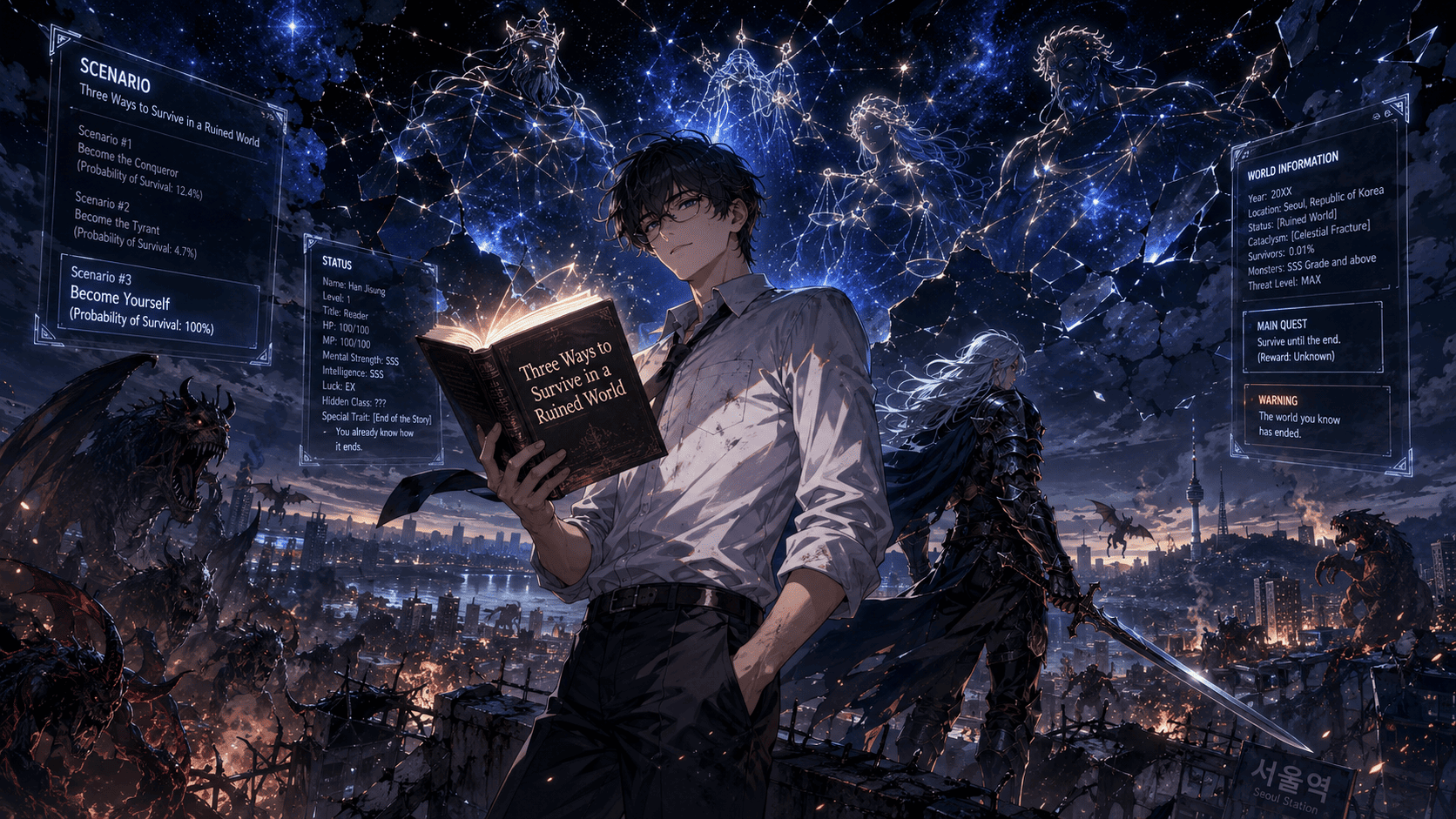
Omniscient Reader’s Viewpoint is a manhwa adaptation of a Korean web novel by the author known as singNsong, illustrated by Sleepy-C with color art by UMI. It follows Kim Dokja, an ordinary office worker who spent 13 years as the sole reader of an obscure web novel called Three Ways to Survive in a Ruined World.
On the day the final chapter is published, the world ends. Or rather: the events of the novel begin to happen in reality. Subway stations transform into apocalyptic dungeons. Civilians are assigned scenarios they must survive. Monsters appear where there were none.
Kim Dokja is the only person alive who knows how the story ends.
What sounds like a power fantasy is actually something much stranger and more interesting. Dokja’s knowledge is not a cheat code. It is a burden. And the story is fundamentally about what you do when you know how something ends and you choose to stay in it anyway.
The Characters
Kim Dokja is not your typical protagonist. He is quiet, guarded, frequently self-sacrificing to the point of self-destruction, and genuinely difficult to read. He does not want to be a hero. He wants the people around him to survive. The gap between those two things is where most of the emotional weight lives.
Yoo Joonghyuk is the novel’s original protagonist, the character who was meant to save the world. His dynamic with Dokja is the engine of the series: two people who should have nothing in common, both surviving a story that only one of them was written into.
The supporting cast earns their place. Lee Hyun-sung, Jung Hee-won, Lee Gilyoung, Yoo Sangah: each one is a full person with a reason to be there, not a function that exists to serve the protagonist. That is rarer in action manhwa than it should be.
Why It Actually Works
The premise is clever. The execution is what makes it exceptional.
ORV is a story about reading. About the relationship between a story and the person who gives it meaning by caring about it. Dokja’s power comes from having read, from having paid attention for 13 years when no one else did. The series keeps returning to that idea: that witnessing something, truly witnessing it, is not a passive act.
For anyone who has ever felt that reading was their primary way of existing in the world, this lands differently than it would for anyone else. The series knows exactly who its reader is, and it writes directly to them.
The power system, built around scenarios and constellations (powerful beings who watch human suffering as entertainment and sponsor survivors in exchange for good content), is intricate without being exhausting. The action sequences are kinetic and clear. But it is the quiet moments, the conversations, the choices made when no one is watching, that stay with you long after the chapter ends.
The Art
Sleepy-C’s artwork is extraordinary. Character expressions carry entire scenes that a lesser artist would need paragraphs to convey. The action is dynamic and readable without becoming cluttered. The color work by UMI gives the series a distinctive palette: deep blues, hot pinks, and bursts of gold that feel deliberate rather than decorative.
The manhwa format suits the story perfectly. Each chapter ends with the kind of momentum that makes “just one more” feel involuntary. The vertical scroll format, in particular, is used thoughtfully. Reveal moments land exactly when they should.
The Film Adaptation
A live-action film adaptation released in Korean theaters on July 23, 2025, followed by a US and Canada release on August 1. For readers of the manhwa, the film works as a companion piece: a different lens on a story you already love. For newcomers, the manhwa is the better starting point. The original source earns the context that makes the emotional moments hit.
Who Should Read It
Read it if you love fantasy that takes itself seriously without losing its sense of wonder. Read it if you want characters who feel like actual people making impossible decisions under impossible circumstances. Read it if you have ever been the one person in a room who read the book everyone else is now watching as a series and felt the particular grief of that.
Skip it if you need a protagonist who is straightforward to root for. Kim Dokja will make you earn it. That is, deliberately, part of the point.
Final Verdict
Omniscient Reader’s Viewpoint is the kind of story that changes what you expect from stories. It is technically a genre manhwa about apocalyptic survival scenarios and supernatural power systems. What it actually is: a meditation on why we tell stories, what it costs to be the person who truly reads them, and what happens when the reader decides to step inside the page.
The internet broke over it for a reason. Read it and find out what that reason is.