15 Brand Positioning AI Prompts to Make Your Brand Clearer
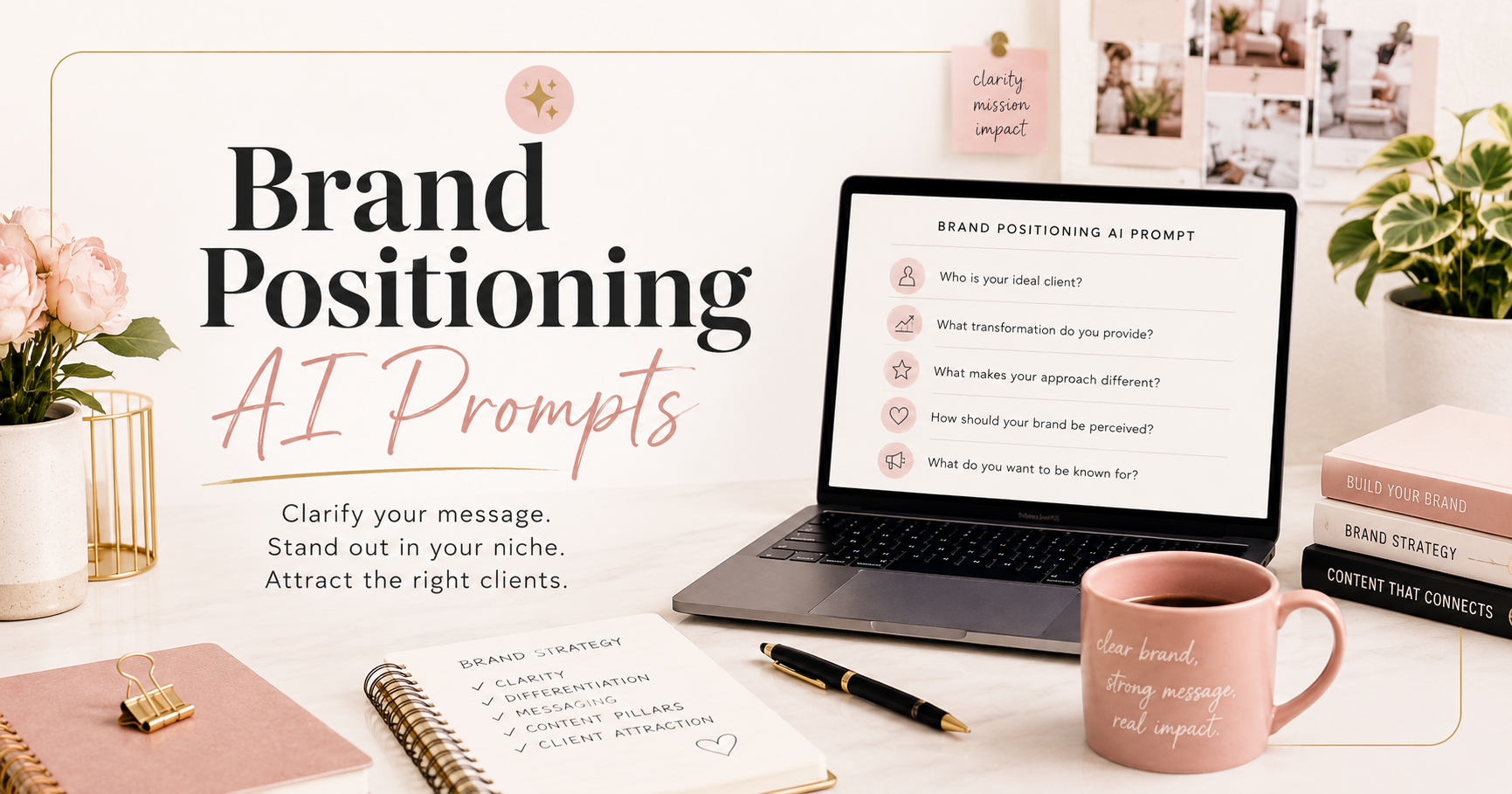
Brand Positioning AI Prompts: How to Make AI Understand What Makes You Different
Your brand is not your logo.
It is not your color palette.
It is not the font you spent three hours choosing because one looked “too corporate” and the other looked “too Pinterest intern.”
Your brand is the reason people choose you.
And in a world where everyone can use AI to write faster, publish more, and sound polished, brand clarity matters more than ever.
Because here is the uncomfortable truth:
AI can help you create content quickly, but it cannot automatically make your brand worth remembering.
That part still needs strategy.
If your brand positioning is vague, AI will only help you produce more vague content at a faster speed. That is not marketing. That is just confusion with better grammar.
So before asking ChatGPT, Claude, Gemini, or any AI tool to write your homepage, Instagram bio, offer page, email sequence, or LinkedIn post, you need to give it better direction.
You need to teach it what your brand stands for.
That is where brand positioning AI prompts become useful.
Not as a shortcut.
As a thinking partner.
What Is Brand Positioning?
Brand positioning is the space your brand owns in your audience’s mind.
It answers simple but important questions:
What do you do?
Who do you help?
What problem do you solve?
Why should people trust you?
What makes your approach different?
Why should someone choose you instead of someone else?
A strong brand position makes people say:
“Oh, this is exactly what I need.”
A weak brand position makes people say:
“This sounds nice, but I’m not really sure what they do.”
That second reaction is where many websites lose visitors.
People usually do not leave because your website is ugly.
They leave because your message is unclear.
Why Use AI for Brand Positioning?
AI is useful for brand positioning because it helps organize messy thinking.
Most business owners, creators, coaches, consultants, and freelancers already have good ideas.
The problem is that those ideas are usually scattered across:
- old website copy
- random notes
- social media captions
- client messages
- half-written offers
- testimonials
- discovery call notes
- voice memos
- ideas you wrote at midnight and forgot by morning
AI can help turn that mess into something structured.
It can help you identify patterns, simplify your message, test positioning angles, compare different audience segments, and turn your ideas into clearer copy.
But AI only works well when you give it useful context.
A generic prompt gives you generic positioning.
A specific prompt gives you something you can actually use.
So instead of asking:
“Write my brand positioning.”
Ask better questions.
The prompts below are designed to help you clarify your brand before you create more content.
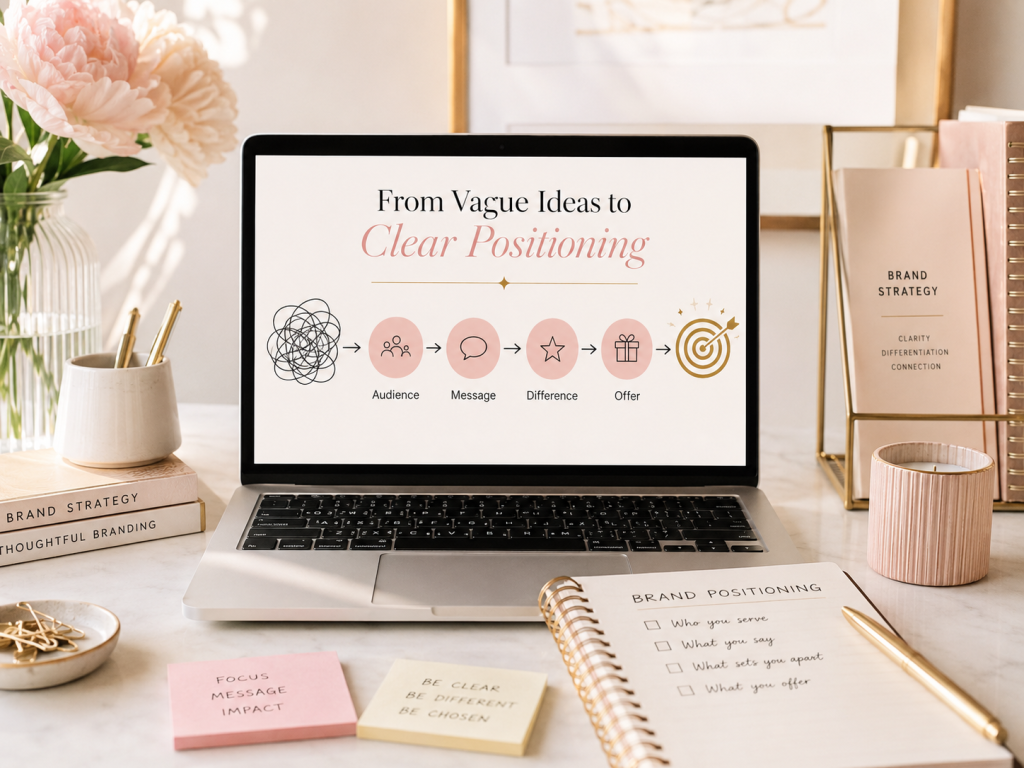
1. The “What Do I Actually Do?” Prompt
Before you polish your brand, you need to simplify it.
This prompt helps remove the vague language that makes your brand sound like everyone else.
Copy and paste this prompt:
Act as a brand strategist. Based on the information below, explain what my brand actually does in plain language. Remove vague phrases, buzzwords, and generic claims. Then summarize my business in one sentence a 10-year-old could understand.

Here is my current brand information:
[Paste your website copy, bio, offer, or notes]
This prompt is useful because it forces clarity.
If AI cannot explain your brand simply, your audience probably cannot either.
2. The Audience Clarity Prompt
One of the biggest branding mistakes is trying to speak to everyone.
When you speak to everyone, no one feels personally addressed.
Use this prompt to get clearer on who your brand is really for.
Copy and paste this prompt:
Analyze my brand and identify the most specific audience I should target. Break the audience down by:

- Their current situation
- Their biggest frustration
- What they have already tried
- What they secretly want
- What language they would use to describe their problem
- What would make them trust a solution like mine

Here is my brand information:
[Paste details]
Good positioning starts with the audience.
Not with what you want to say.
With what your audience is already thinking.
3. The Differentiation Prompt
This is where most brands get uncomfortable.
You need to know why someone should choose you instead of another person offering something similar.
And no, “I care about my clients” is not enough.
Everyone says that.
Use this prompt to find more specific differences.
Copy and paste this prompt:
Based on my brand information, identify what makes my approach different from competitors. Do not give generic answers like “personalized support” or “high quality.” Find specific differences in my process, perspective, audience, method, values, lived experience, offer structure, or results.

Then turn those differences into 5 possible positioning angles.

Here is my brand information:
[Paste details]
Good differentiation is not always about being completely original.
Sometimes it is about being more specific.
4. The Competitor Comparison Prompt
You do not need to obsess over competitors.
But you do need to understand the market you are entering.
If every person in your niche is saying the same thing, your brand needs a sharper angle.
Copy and paste this prompt:
Act as a positioning strategist. Compare my brand against typical competitors in my niche. Identify:

- What most competitors say
- What claims are overused
- Where the market feels saturated
- What my brand can say instead
- What emotional or practical gap I can own

My brand:
[Paste details]

My niche:
[Describe niche]
This helps you avoid blending in.
Because “I help ambitious women unlock their next level” might sound good until you realize thousands of people are saying almost the same thing.
5. The “Category of One” Prompt
The best brands are easy to understand but hard to replace.
They do not just sell a service.
They own a perspective.
This prompt helps you find a more memorable positioning angle.
Copy and paste this prompt:
Help me position my brand as a “category of one.” Based on my background, offer, audience, and point of view, suggest 10 unique brand positioning concepts that combine what I do with who I serve and how I do it differently.

For each concept, include:

- Positioning statement
- Ideal audience
- Core promise
- Why it feels different
- Possible tagline
This is especially useful for coaches, consultants, creators, and solo business owners.
You are not only selling what you do.
You are selling how you see the problem.
6. The Value Proposition Prompt
Your value proposition should not sound like a motivational poster.
It should explain what you do in a way people understand quickly.
Use this prompt to make your value proposition clearer.
Copy and paste this prompt:
Create 10 value proposition options for my brand. Each one should clearly explain:

- Who I help
- What problem I solve
- What outcome I create
- Why my approach is different

Avoid vague words like empower, transform, elevate, unlock, and thrive unless they are supported by specific meaning.

Here is my brand information:
[Paste details]
A weak value proposition sounds pretty.
A strong one makes people understand why they should care.
7. The Homepage Hero Prompt
Your homepage hero section has one job:
Make the right visitor keep reading.
That is it.
It does not need to be clever. It needs to be clear.
Copy and paste this prompt:
Write 10 homepage hero section options for my brand. Each option should include:

- Headline
- Subheadline
- Primary call-to-action
- Secondary call-to-action

Make the copy clear, specific, and conversion-focused. Avoid hype. The visitor should understand what I do within 5 seconds.

Brand information:
[Paste details]
This is one of the most useful AI prompts if you are building or improving your website.
Your homepage is not a poem.
It is a decision point.
8. The Offer Positioning Prompt
Sometimes your brand is not the problem.
Your offer is.
If people are confused about what they are buying, they will not buy.
Use this prompt to make your offer easier to understand.
Copy and paste this prompt:
Analyze my offer and improve its positioning. Identify:

- The exact problem this offer solves
- The audience most likely to buy it
- The strongest outcome
- The weakest or most confusing part of the offer
- The best way to explain the offer in one sentence
- 5 improved offer names
- 5 stronger offer descriptions

Offer details:
[Paste offer]
AI is very good at spotting where your offer sounds abstract.
Let it be honest.
Then fix the confusing parts.
9. The Brand Voice Prompt
Brand voice is not just “friendly” or “professional.”
Those words are too broad to be useful.
Your brand voice should describe how you sound when you are at your clearest.
Copy and paste this prompt:
Create a brand voice guide for my business. Include:

- 5 voice traits
- What my brand should sound like
- What my brand should avoid sounding like
- Words and phrases to use often
- Words and phrases to avoid
- 3 sample paragraphs in this voice
- 5 social media captions in this voice

Brand information:
[Paste details]
Once you have a brand voice guide, save it.
Use it every time you ask AI to write content for your brand.
That alone can improve your AI output dramatically.
10. The Messaging Pillars Prompt
If you never know what to post, you may not have a content problem.
You may have a messaging problem.
Messaging pillars are the core ideas your brand repeats until people remember you.
Copy and paste this prompt:
Based on my brand positioning, create 5 messaging pillars for my content strategy. For each pillar, include:

- Main idea
- Why my audience cares
- Topics I can create content about
- Contrarian angle
- Example post title
- Example call-to-action

Brand information:
[Paste details]
Messaging pillars help your content feel consistent instead of random.
And consistency is what makes a brand recognizable.
11. The “Hot Take” Positioning Prompt
Safe content is forgettable.
You do not need fake controversy.
You do need a point of view.
This prompt helps you find thoughtful opinions that can make your content more shareable.
Copy and paste this prompt:
Based on my brand, generate 15 strong points of view I can use in my content. These should be thoughtful, slightly contrarian, and relevant to my audience. Avoid clickbait. Each point of view should challenge a common belief in my industry.

Brand information:
[Paste details]
People share content that says what they were already thinking but had not yet found the words for.
That is why strong points of view matter.
12. The Client Language Prompt
Your audience’s words are usually better than your words.
If you have testimonials, reviews, discovery call notes, comments, or DMs, use them.
This prompt helps you turn real audience language into stronger brand messaging.
Copy and paste this prompt:
Analyze the client language below. Identify the exact phrases my audience uses to describe:

- Their pain points
- Their desired outcomes
- Their objections
- Their fears
- Their buying triggers
- The results they value most

Then suggest how I can use this language in my website, offer page, and social content.

Client language:
[Paste testimonials, DMs, call notes, reviews, or comments]
This is one of the highest-value prompts on this list.
Great copy often comes from listening better.
13. The Positioning Statement Prompt
Once you have the raw material, turn it into a clean positioning statement.
This gives your brand a simple strategic foundation.
Copy and paste this prompt:
Create 10 positioning statements for my brand using this structure:

I help [specific audience] achieve [specific outcome] without [specific pain/frustration] through [unique method or approach].

Make each version clear, specific, and differentiated.

Brand information:
[Paste details]
Do not expect the first answer to be perfect.
The goal is to generate options.
Then refine.
14. The Brand Story Prompt
Your brand story should not be a diary.
It should explain why your work matters.
A good brand story connects your background to the problem you solve today.
Copy and paste this prompt:
Help me write a brand story that connects my background to the problem I solve today. Structure it like this:

- What I noticed
- Why it frustrated me
- What I learned
- What I now believe
- How my brand helps people differently because of this

Keep it human, specific, and relevant to my audience. Avoid making it sound overly dramatic.

My background:
[Paste details]
The best brand stories build trust.
They do not just list credentials.
15. The Final Brand Positioning Brief Prompt
After you run the earlier prompts, use this one to pull everything together.
Think of it as your brand positioning master document.
Copy and paste this prompt:
Create a complete brand positioning brief for my business. Include:

1. Target audience
2. Audience problem
3. Audience desire
4. Core brand promise
5. Unique positioning angle
6. Differentiators
7. Value proposition
8. Brand voice
9. Messaging pillars
10. Homepage headline options
11. Offer positioning
12. Social media bio options
13. One-sentence brand summary
14. 30-day content strategy based on this positioning

Use the information below:
[Paste your best outputs from previous prompts]
This is the prompt that turns scattered ideas into a usable brand system.
Not just content.
A system.
How to Get Better Answers From AI
The quality of your AI output depends on the quality of your input.
Do not give AI one sentence about your business and expect it to produce genius.
Give it context.
Include things like:
- your current bio
- your website copy
- your offers
- your audience
- your testimonials
- your competitors
- your values
- your process
- your strongest results
- your personal story
- your content ideas
- your old drafts
- your audience’s actual words
The more useful context you give, the more useful the answer becomes.
AI is not a mind reader.
It is a pattern finder.
Give it better patterns.
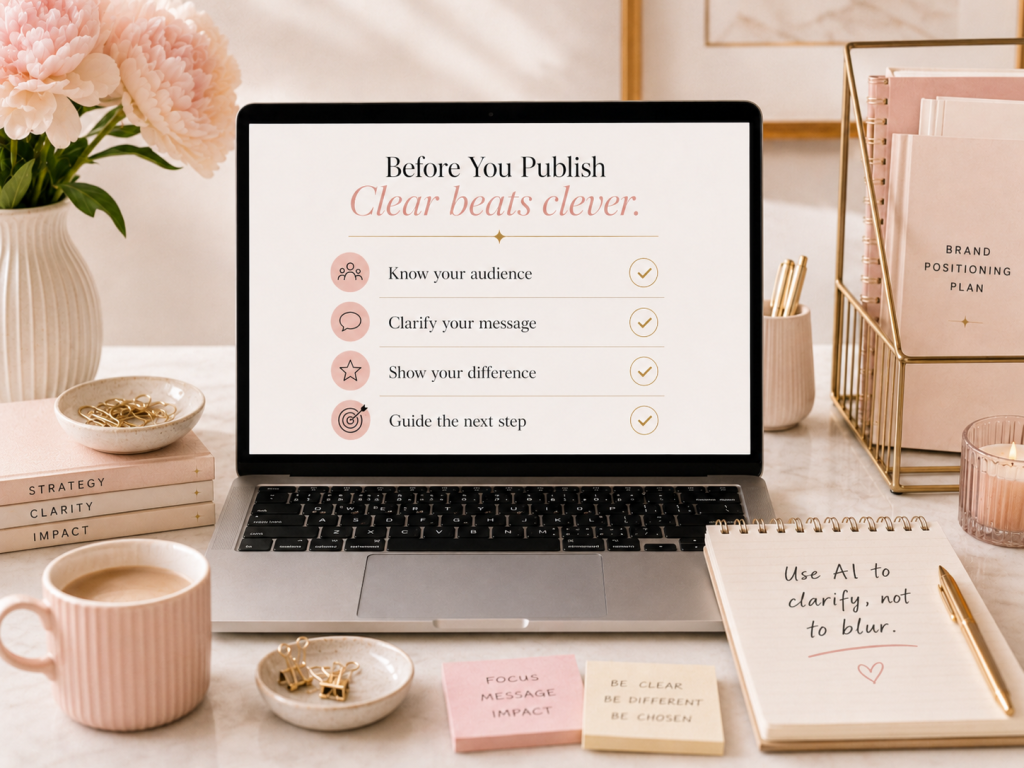
A Simple Workflow for Using These Prompts
Do not run all 15 prompts randomly.
Use them in this order:
- Clarify what you do.
- Define who you help.
- Identify what makes you different.
- Create your positioning statement.
- Improve your offer positioning.
- Write your homepage hero section.
- Build your messaging pillars.
- Turn those pillars into content.
That order matters.
Because if you skip positioning and jump straight into content, you may end up with polished posts that do not lead anywhere.
Pretty content does not fix unclear strategy.
Should You Use AI-Generated Content for SEO?
Yes, but only if you use it well.
Google has said that using generative AI is not automatically against its guidelines. The issue is not whether AI helped create the content. The issue is whether the content is helpful, reliable, original, and created for people rather than only for rankings.
That means you should not publish raw AI output without editing it.
Before publishing AI-assisted content, ask:
Does this add something useful?
Does this sound like my actual brand?
Does it include real examples?
Is it clear who this is for?
Would someone bookmark this?
Would I trust this if I found it on Google?
Does this help the reader make a better decision?
If the answer is no, keep editing.
AI can help you draft.
But your judgment makes the content worth publishing.
The Biggest Mistake People Make With AI Branding
The biggest mistake is asking AI to make your brand sound impressive.
That is not the goal.
The goal is to make your brand easy to understand, easy to remember, and easy to choose.
Impressive language often creates distance.
Clear language creates trust.
Your audience does not need more clever words.
They need to know:
“This is for me.”
“This person understands my problem.”
“This solution makes sense.”
“I know what to do next.”
That is brand positioning.
Final Thought: AI Will Not Make Your Brand Different. But It Can Help You Find What Already Is.
AI cannot invent your credibility.
It cannot replace your lived experience.
It cannot magically create a strong brand if you have no point of view, no audience clarity, and no real offer.
But it can help you uncover the strongest parts of what already exists.
It can help you notice patterns.
It can help you sharpen your message.
It can help you stop hiding behind vague language.
And that might be the most useful thing AI can do for your brand.
Because the brands that win are not always the loudest.
They are the clearest.
Need Help Turning AI Into Clearer Content?
At The Glow Up Code, we help creators, freelancers, coaches, consultants, and small business owners use AI to clarify their message, build better content, and create online systems that actually support their goals.
Your content should not just fill space.
It should make people understand why you are the one they have been looking for.
Start with your positioning.
Then let AI help you build from there.
Optional FAQ Section for SEO
You can add this at the bottom of the article using a normal heading block.
FAQ: Brand Positioning AI Prompts
What are brand positioning AI prompts?
Brand positioning AI prompts are instructions you give to AI tools like ChatGPT, Claude, or Gemini to help clarify your audience, value proposition, messaging, offers, and unique brand angle.
Can AI help with brand strategy?
Yes. AI can help organize ideas, compare positioning angles, simplify messaging, and generate strategic options. However, the best results come when you add your own experience, audience insight, and editorial judgment.
Are AI-generated blog posts bad for SEO?
Not automatically. Google’s guidance focuses on whether content is helpful, reliable, original, and created for people. AI-assisted content should be edited, fact-checked, and improved with real examples before publishing.
What should I give AI before asking for brand positioning help?
Give AI your website copy, bio, offer details, audience description, testimonials, competitor notes, values, process, and examples of your existing content. Better context leads to better output.
Who should use brand positioning prompts?
These prompts are useful for coaches, freelancers, consultants, creators, small business owners, service providers, and anyone building a personal or business brand online.
If you are building a website, start with your positioning first, then use AI-powered content support to turn that strategy into homepage copy, blog posts, and offer pages.

At The Glow Up Code, we use prompts like these before writing website copy because unclear strategy creates unclear content.